


Frequently Asked Questions
As the Key Bridge Rebuild effort is under active development, please continue to check back as new questions will continue to be added based on your feedback and as the project progresses.
About the New Bridge
The current goal is to open the new bridge to traffic by 2030, which was announced in November 2025. The construction schedule and opening date will be refined as MDTA awards the remaining contracts for the rebuild and receives contractor schedules. MDTA will continue to share schedule updates and key milestones as the project advances.
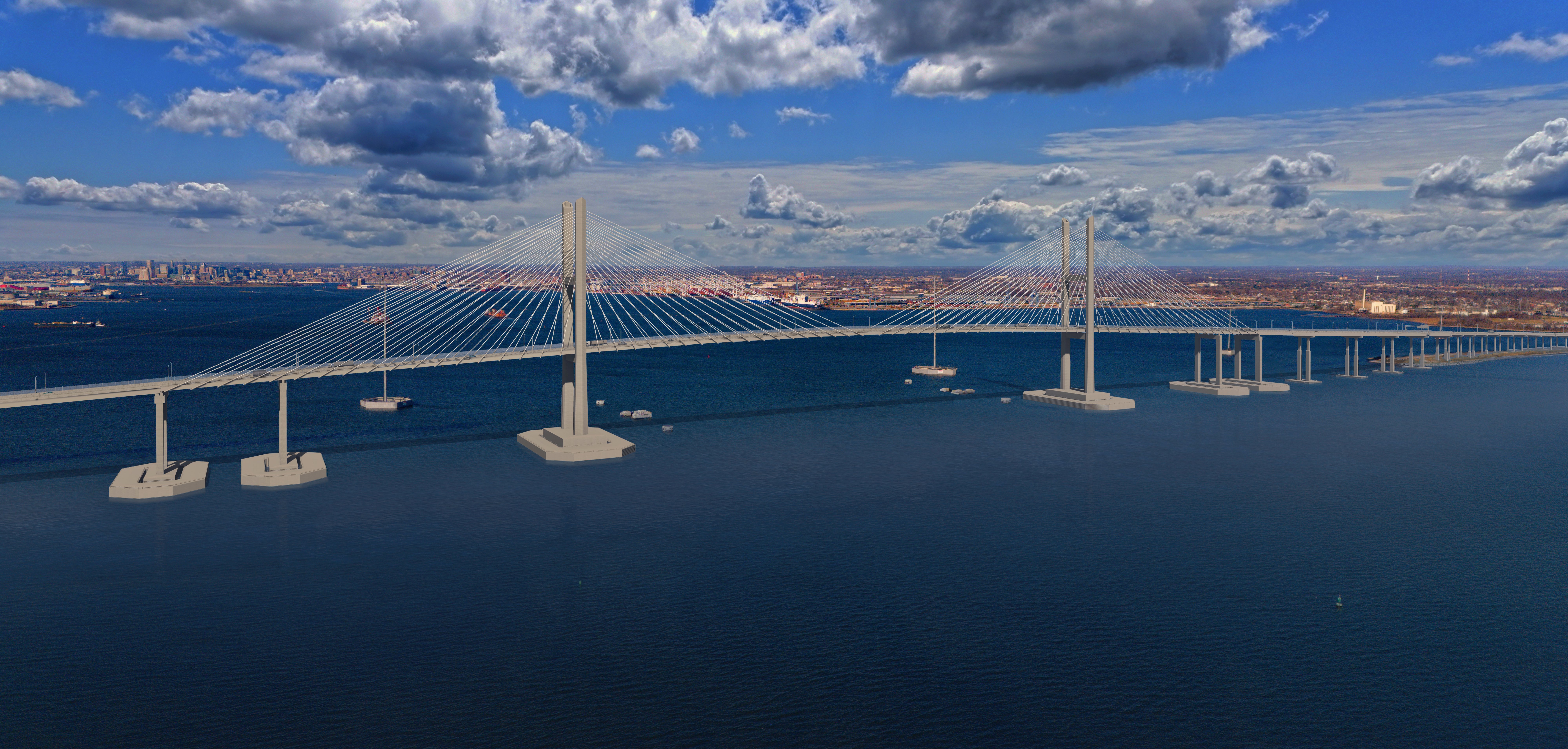
The new bridge will be Maryland’s first highway cable-stayed bridge, which will consist of two lanes in each direction and have a minimum vertical clearance of 230 feet to support larger vessels. It will be constructed according to current industry standards and infrastructure design practices. Cable-stayed bridges have proven to be the most economical for bridges with similar span lengths and allow for a faster construction time compared to other complex bridge types.
There will be two 12-ft lanes with a 10-ft outside shoulder and a 4-ft inside shoulder in each direction, separated by a concrete median.
The new bridge will include pier protection structures designed using the latest American Association of State Highway and Transportation Officials (AASHTO) specifications and modern vessel-collision protection practices. The main span will also be longer than the former bridge, providing additional clearance between the bridge piers and the federal navigation channel.
Yes, the new Key Bridge will be built in sections using three contracts: the north land approach, south land approach, and main span and marine approaches. See the question below on the procurements related to the new Key Bridge.
Construction and Progress
Yes. Construction is progressing on the new Key Bridge, with significant progress being made both on and off the water. All 90 permanent foundation piles for the north and south pylons have been fabricated, delivered and installed in the riverbed. Crews are now advancing installation of the pier protection piles, with this work expected to continue through spring 2027.
Other completed and ongoing work includes the test pile program, land demolition and constructing temporary trestles from both sides of the Patapsco River to provide access for crews and equipment.
Visit the Construction page for the latest information on ongoing, completed and pre-construction activities. Learn More
Safety, Waterway and Environmental Protections
MDTA is working with state and local partners to help protect boaters, marine workers and construction personnel during the Key Bridge Rebuild. Through the Smooth Waters Initiative, MDTA provides information about navigating safely near the construction area and works to minimize impacts on the Patapsco River and surrounding communities.
Boat traffic is limited to the areas between the former main span piers, including the federal navigation channel and the 150-foot buffer areas on either side of the channel near the construction site. The Maryland Department of Natural Resources has also established a 6-knot speed zone extending 1,500 feet upstream of the former bridge and 1,500 feet downstream of the new bridge, excluding the federal navigation channel. Learn More
Environmental protection is an important part of the Key Bridge Rebuild. The Federal Highway Administration (FHWA) determined that the replacement bridge will have limited environmental impacts because it remains within MDTA’s right-of-way and maintains the same four-lane capacity.
The project team uses monitoring and construction practices to understand and minimize potential impacts throughout construction. Noise and vibration monitors collect data during construction activities, and water quality monitoring is conducted to confirm that activities are not negatively impacting the riverbed. Protected species observers also monitor wildlife near active work areas.
During pile-driving operations, bubble curtains are used to reduce underwater noise and help deter fish and other wildlife from entering active construction areas.
Demolition and Engineering
Mechanical demolition of the existing Key Bridge structures over land began in Spring 2025 and was completed in February 2026. Crews removed more than 20,000 tons of concrete decking, concrete columns and 175 steel girders from the north and south sides of the bridge.
The next phase of demolition will focus on the remaining structures over water, including girders, marine piers and foundations. The remaining land pier on each side of the river will also be removed.
Test pile driving and associated load testing allowed the project team to confirm how the bridge’s foundation piles would perform in the soil beneath the Patapsco River before the permanent pile installation advanced. The test pile program began in October 2025 and was successfully completed in February 2026.
The results confirmed the strength and performance of the foundation design, allowing the team to moved into permanent pile installation.
Contracting and Next Steps
The original progressive design-build contract allowed MDTA and the progressive design-builder to work together during the first phase to advance the design and develop a proposed price and schedule for the next phase of construction. When an agreement for the next phase could not be reached, MDTA used a standard provision of the contract to deliver the remaining work using new procurements.
MDTA is now advancing multiple contracts for the remaining construction. This approach is intended to increase competition within the contracting community, expand opportunities for the local workforce and expedite the award of new contracts.
Work on the Key Bridge Rebuild is continuing while MDTA advances the new contracts for the remaining construction. The current progressive design-builder will complete contractual responsibilities, including installation of foundation piles for the main bridge pylons and associated pier protection piles, as well as construction of temporary trestles (work platforms) from both sides of the river to the main pylon areas. This work is expected to be completed by Spring 2027.
At the same time, MDTA is advancing procurements for the remaining bridge, demolition and approach work so that construction and procurement activities can continue in parallel.
MDTA is moving forward with four planned contracts to complete the remaining Key Bridge Rebuild work. Dividing the work into multiple contracts is intended to increase competition within the contracting community, expand opportunities for the local workforce and expedite the award of new contracts.
- Main Span and Marine Approaches: Construction of the main span bridge, pier protection structures and marine approach bridges.
- Demolition and Miscellaneous Marine Work: Demolition of the remaining structures over water and other miscellaneous marine work.
- South Land Approach: Construction of the south land approach bridge and associated roadway work.
- North Land Approach: Construction of the north land approach bridge and associated roadway work.
The State of Maryland received settlement funds from the owner and manager of the DALI. Under the American Relief Act, 2025, the federal government will provide funding for eligible rebuild costs not covered by compensation recovered from responsible parties.
Opportunities, Resources and Staying Connected
The four planned contracts will be advertised through Maryland’s online procurement platform, eMaryland Marketplace Advantage (eMMA). Pre-bid or pre-proposal meetings will be identified in the individual procurements. Learn More
Visit Commuter Choice Maryland for free resources and incentives to support employees and employers.
KeyBridgeRebuild.com is the central source for project information and updates. You can also follow @KeyBridgeRebuild on Facebook, join the project mailing list and subscribe to text for project updates and events. For questions or to request a project speaker, contact [email protected] or 800-515-7030.
The Key Bridge Dashboard provides a snapshot of the project’s progress, bringing key information together in one place so the public can easily track how the rebuild is advancing. It includes measurable construction progress, completed activities, design and procurement milestones, and stakeholder engagement efforts.
The Dashboard will be refreshed monthly. As with any complex, multi-year infrastructure project, the pace and visibility of progress may vary from month-to-month based on the type, complexity, and seasonality of the work underway.
Yes. A memorial is planned to honor the original Francis Scott Key Bridge and the six workers who lost their lives. Formal plans have not yet been finalized, and additional information will be shared as planning advances.
Sign Up for Alerts
I would like to opt-in to receive project related emails and/or text messages from the Key Bridge Rebuild team.